
Updated 14 Oct 2026
The short answer
A typical home solar panel system of about 4.5 kW costs around £7,600 fitted, according to the Energy Saving Trust. Most homes pay £5,000 to £10,000 depending on the size: about £5,000 to £8,000 for a 3 to 4 kW system and £7,000 to £10,000 for 5 to 6 kW.
Fitting a battery at the same time takes a typical system to about £8,000 to £16,000. Solar panels and batteries fitted in a home carry 0% VAT until 31 March 2027.
Solar panel prices by system size
Typical 2026 prices, supplied and fitted, without a battery, from the guides listed under Sources. Sizes are in kilowatts (kW): the most the panels make in full sun.
| System | Supplied and fitted |
|---|---|
| 3 to 4 kW, about 8 to 10 panels | £5,000 to £8,000 |
| 4 to 5 kW, typical for 2 to 3 bedrooms | £6,600 to £9,000 |
| 5 to 6 kW, about 12 to 14 panels, for 4 bedrooms or more | £7,000 to £10,000 |
| 7 kW or more, 16 panels or more | £10,000 to £13,000or more |
Each range runs from the lowest to the highest 2026 figure in the guides we checked. The 7 kW band comes from one guide.
What solar really cost: the government's figures
The government publishes what solar panels actually cost, from every MCS-registered installation in Great Britain. From April 2025 to March 2026, homes paid on average:
| Home systems, April 2025 to March 2026 | Average cost |
|---|---|
| Up to 4 kW | £1,955per kW, fitted |
| 4 to 10 kW | £1,645per kW, fitted |
Department for Energy Security and Net Zero, solar PV cost data (official statistics in development). Includes VAT where it applied; batteries are not included. Bigger systems cost less per kW, and after allowing for inflation the cost per kW fell for every size of system on the year before.
Adding a home battery
A battery stores the electricity your panels make during the day, so you can use more of it in the evening. Typical 2026 prices, supplied and fitted:
| Battery | Supplied and fitted |
|---|---|
| Solar panels and a battery, fitted together | £8,000 to £16,000 |
| A battery of about 5 kWh | £3,000 to £5,500 |
| A battery of about 10 kWh | £4,000 to £10,000 |
| A battery added to panels you already have | £3,000 to £10,500 |
Battery prices vary a lot by brand and size, and the guides disagree most on 10 kWh batteries. One guide says adding a battery later usually costs £500 to £1,000 more than fitting it with the panels, because it needs a separate visit and its own wiring.
What changes the price
- The size of the system. More panels cost more in total but less per kW, because the labour, the scaffolding and the inverter cost much the same either way.
- Scaffolding and access to your roof. One guide puts scaffolding at £300 to £1,200, and one installer says labour and scaffolding are usually the biggest single part of the price.
- Your roof. Repairs, strengthening to carry the panels or special fixings for a slate roof add to the cost: one guide puts repairs or strengthening at £300 to £1,000.
- The electrics. An older consumer unit (fuse box) may need replacing, which one guide puts at £400 to £800.
- The panels. More efficient panels cost more.
- Extras such as bird proofing, which one guide puts at £500 to £900.
- Panels or tiles. Solar roof tiles cost more than twice as much as panels on average, one installer says, mostly because the whole roof covering is replaced.
- Flat roofs and ground mounts need extra frames, so they can cost more than a pitched roof.
- Where you live. On the government's figures London costs the most per kW: about £2,100 for systems up to 4 kW, against about £1,760 in the North East.
- Doing it with other work. If scaffolding is already up for roof work, or the house is being built, it costs less.
How long it takes
Your installer registers the system, and any battery, with your local electricity network operator, the company that brings electricity to your home.
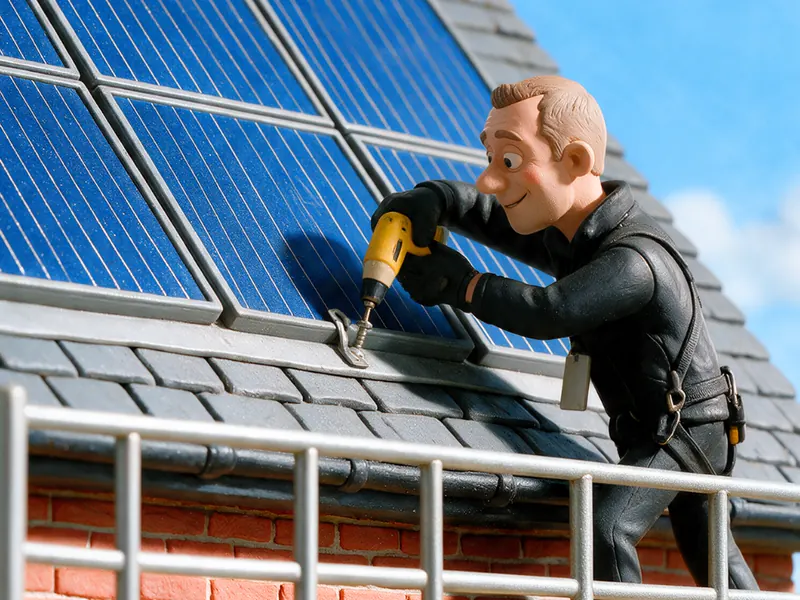
- A typical system: one to two days, often one day with two installers. Scaffolding may go up a few days before.
- A larger system, over 14 panels: up to four days.
- Adding a battery to panels you already have: half a day to a day. Nothing changes on the roof, so there is no scaffolding.
VAT, export payments and savings
VAT. Solar panels and home batteries fitted in a home carry 0% VAT until 31 March 2027, including a battery added to panels you already have. From 1 April 2027 the rate goes back to 5%. The zero rate only applies when they are installed: buying panels or a battery on their own carries the standard rate.
Export payments. Under the Smart Export Guarantee, electricity suppliers pay you for the electricity you send to the grid. Each sets its own rate, which must be above zero, and it does not have to be your own supplier. You need an MCS certified installation and a smart meter that records exports. It is not available in Northern Ireland.
Savings. The Energy Saving Trust says export typically pays around 12p a unit, less than half what you pay to buy electricity, so using your own power is worth more. On July 2026 prices it puts the payback time at 9 to 12 years with export payments, depending on where you live and how much you are at home. Your own figures depend on your roof, your use and your tariff.
Do you need planning permission for solar panels?
In England, panels on a house are often permitted development, with no need to apply, if the limits are met. On a pitched roof they must not sit above the highest part of the roof (not counting the chimney) or stand more than 200mm proud of the slope. On a flat roof they must be no more than 600mm above the highest part of the roof.
They are not allowed on a building within the grounds of a listed building. In a conservation area or World Heritage Site they must not go on a wall, balcony or roof enclosure that faces a road.
The rules changed on 27 August 2026. Until 27 August 2027 either the old or the new rules can be followed, so ask your installer which they are using. These are the rules for England; Wales may differ. If in doubt, ask your council.
What a good quote includes
The Energy Saving Trust advises getting quotes from at least three MCS certified installers. Be wary of pressure to sign on the first visit: a good installer leaves you a written quote and time to think.
- The system size, and how they worked it out from your electricity use.
- The panels, the inverter and any battery, by make and model.
- Scaffolding, and any roof work or bird proofing.
- Any electrical work, such as a new consumer unit.
- MCS certification for the installer and the products, and the paperwork you get at the end.
- Registering the system with the network operator.
- The warranties for the panels, the inverter, the battery and the workmanship.
- VAT at 0% if the work is done by 31 March 2027.
How we worked out these prices
We read the 2026 price guides listed under Sources on 14 October 2026, alongside the government's installed cost data. Each range runs from the lowest to the highest 2026 figure among the guides; nothing is averaged. Several guides come from installers or quote websites, and they do not always agree, which is why we show the whole range.
They are typical prices, not quotes. The installer who looks at your roof and your bills is the one who can price your system.
Get quotes from MCS certified installers we have checked
Tell us about your home in about 60 seconds and we match you with local MCS certified installers we have checked. It is free, and there is no obligation to go ahead.
Get quotesOr read how to choose a solar installer.

How we check them
- Public liability insurance. Covers damage to your home and injury to anyone while panels are carried up and fixed to your roof. We see it before an installer can be matched with you.
- MCS certification. MCS is the UK's quality mark for small-scale renewables. MCS lists certification as one of the requirements to be paid for the electricity you export under the Smart Export Guarantee, and advises checking that both the installer and the products are MCS certified.
- NICEIC or NAPIT registration. Building regulations apply to the electrical installation as well as the roof. In England a complete new circuit or a new consumer unit is notifiable, and an electrician registered with a competent person scheme can self-certify it.
- Checked by a person. Our team reads their reviews and approves every business before it can reach you.
Questions
How much do solar panels cost in 2026?
Around £7,600 for a typical 4.5 kW home system, according to the Energy Saving Trust. Most homes pay £5,000 to £10,000 depending on the size, and more with a battery.
How much does a solar battery cost?
About £3,000 to £5,500 for a 5 kWh battery and £4,000 to £10,000 for about 10 kWh, supplied and fitted. Prices vary a lot by brand.
Is there VAT on solar panels?
Not until 31 March 2027: solar panels and batteries fitted in a home carry 0% VAT. From 1 April 2027 the rate goes back to 5%.
How long do solar panels take to pay for themselves?
The Energy Saving Trust puts it at 9 to 12 years with export payments, on July 2026 prices, depending on where you live and when you are at home. Your own use and tariff decide it.
How long do solar panels last?
Twenty-five years or more, says the Energy Saving Trust. The inverter usually needs replacing after about 12 years.
Do I need planning permission for solar panels?
Usually not for a house in England, if the panels stay within the height limits. Listed buildings, conservation areas and World Heritage Sites have extra rules, so check with your council.
Is it free to use QuoteMy?
Yes. It is free for homeowners and there is no obligation to go ahead with any quote.
Sources
- Energy Saving Trust: solar panels
- Energy Saving Trust: solar panel battery storage
- Energy Saving Trust: Smart Export Guarantee
- Energy Saving Trust: solar panel installation, step by step
- GOV.UK (DESNZ): solar PV cost data
- HMRC: VAT on energy-saving materials and heating equipment (Notice 708/6)
- Ofgem: Smart Export Guarantee
- Ofgem: Smart Export Guarantee, generators
- MCS: for consumers
- Planning Portal: solar panels, planning permission
- Planning Portal: solar equipment mounted on a house
- Homebuilding & Renovating: renewables costs
- The Eco Experts: solar panel cost
- The Eco Experts: solar battery cost
- Checkatrade: cost of solar panel installation
- Sunsave: solar panel costs guide
- EnergyPlus: adding a battery to existing solar panels