
Updated 12 Oct 2026
The short answer
A combi boiler usually suits a home with one bathroom, because it heats water from the mains as you use it and needs no cylinder. A system boiler usually suits two or more bathrooms, because it stores hot water in a cylinder so several taps and showers can run at once.
What each costs, fitted
| Job | From | Up to |
|---|---|---|
| Replace a combi with a new combi | £2,350 | £4,000 |
| Replace a system or regular boiler, keeping the tank | £2,800 | £3,100 |
| Switch from a tank system to a combi | £3,650 | £5,300 |
| Replace a back boiler with a combi | £4,050 | £5,700 |
Our guide price for a 3-bedroom home on mains gas, boiler staying in place. Every model and extra priced.
Which boiler do you have now?
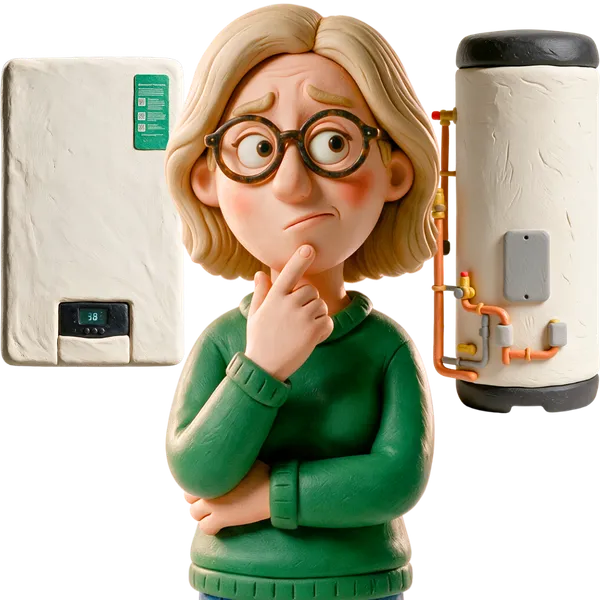
Look in your airing cupboard. If there is a hot water cylinder there, you do not have a combi: you have a system boiler, or a regular boiler if there is also a cold water tank in the loft. If there is no cylinder and hot water comes straight from the boiler when you turn on a tap, you have a combi.
Your boiler's make and model is usually on a label on the front or underneath. Searching for it will tell you the type too.
Combi vs system boiler at a glance
- Hot water: a combi heats it on demand; a system boiler heats a cylinder of stored water.
- Showers at once: a combi is best with one hot tap or shower at a time; a system boiler can serve several.
- Space: a combi needs no cylinder and no loft tanks; a system boiler needs room for a cylinder, but no loft tanks.
- Water pressure: a combi depends on your mains supply; a system boiler depends on the size of its cylinder.
- If the boiler breaks down: a combi gives no hot water; a cylinder with an immersion heater can still give you hot water.
- Solar water heating: a combi does not work with it; a system boiler can, with a suitable cylinder.

How a combi boiler works
A combi, short for combination, does your heating and your hot water in one compact unit. Cold water comes in from the mains and the boiler heats it the moment you turn on a hot tap. Which? describes the combi as the most common type of boiler in the UK.
Because nothing is stored, you never wait for a tank to heat up and you never run out. The trade off is that the hot water is shared: run a shower and the kitchen tap together and both will feel it. How strong the shower is also depends on your mains water supply.
- No hot water cylinder and no tanks in the loft, which frees up a cupboard.
- Hot water on demand, at mains pressure.
- Best when one hot tap or shower is used at a time.
How a system boiler works
A system boiler heats your radiators directly and heats a separate hot water cylinder, usually kept in an airing cupboard. The main parts, such as the pump and expansion vessel, are inside the boiler, so there are no water tanks in the loft.
Because the hot water is stored, it can feed a bath, a shower and the kitchen tap at the same time. The limit is the size of the cylinder. Vaillant suggests allowing around 50 litres of stored hot water per person, and if a busy morning empties the cylinder, it can take 30 to 40 minutes to heat up again.
- Needs room for a hot water cylinder, but not loft tanks.
- Several taps and showers can run at once.
- Can work with solar water heating panels when paired with a suitable cylinder.
Is a system boiler better than a combi?
Neither is better in every home. Each one is better at a different job, and the right choice is the one that matches how your household uses hot water.
- One bathroom, a smaller household, or not much space: a combi usually suits.
- Two or more bathrooms, or several people showering at the same time: a system boiler with a cylinder usually suits better.
- Low mains water pressure or flow: a combi may not give a good shower, so an installer should check your water supply before recommending one.
- No space for a cylinder: a combi is usually the answer, as long as your hot water needs are modest.
- Hot water matters even when the boiler is off: a cylinder with an immersion heater gives you a backup.
Can a combi boiler cope with two bathrooms?
It can, if the two bathrooms are rarely used at the same time and your mains water supply is strong. Baxi's advice is that a combi is not suitable where more than one bathroom is used at the same time, because the hot water is shared between the taps that are open.
If your household often runs two showers together, a system boiler with a cylinder usually gives a better result. There is also a middle option: a storage combi has a small hot water store built into the boiler, which helps with higher demand without a separate cylinder. Which? notes that these stores are much smaller than the largest cylinders used with system boilers.
Is a combi or a system boiler cheaper to run?
For most homes a combi uses a little less energy for hot water, because it only heats the water you use and there is no stored water slowly losing heat in a cylinder. Ideal rates combi boilers as high efficiency and system boilers as moderate for this reason.
In a home with heavy hot water use, a well insulated cylinder still works well, and the bigger difference to your bills is choosing a boiler of the right type and size, set up properly. A guide price for each option can help you compare before an installer visits.
What about a regular boiler?
A regular boiler, also called a heat only or conventional boiler, is the older set up: a hot water cylinder plus a cold water tank and a small expansion tank in the loft. It is often found in older homes, and Baxi notes it can be a good option where the mains water pressure is low.
If you have one now, you can usually replace it with another regular boiler, change to a system boiler, or change to a combi. Each change means different pipework, so ask the installer to explain what your home needs and why.
Changing from a system boiler to a combi
Swapping like for like, such as a combi for a new combi, is the simplest job. Changing from a cylinder and tanks to a combi means taking the cylinder and any tanks out and changing the pipework. Ideal puts a change of boiler type at around two to three days of work, against a day for a straight swap. The reverse, adding a cylinder, also means extra work.
Changing type can be worth it, for example when a family has grown, or when a combi frees up a cupboard you would use. It is not worth it just because one type is more fashionable. In England, a new combi also has to be fitted with one extra energy saving measure, such as smart controls with automation and optimisation, or weather compensation, under rules that started in April 2018.
Thinking about a heat pump later?
A standard air source heat pump does not give hot water on demand like a combi, so it needs a way of storing hot water, usually a cylinder. The Energy Saving Trust says a cylinder can usually fit in a cupboard of at least 80cm by 80cm.
If you might move to a heat pump in future, it is worth weighing up before you give away an airing cupboard. It is not a reason on its own to choose one boiler over the other.
Underfloor heating with a combi or a system boiler
Both can run wet underfloor heating. Viessmann notes that with a combi, where the radiators and the underfloor heating run off the same boiler, a heating engineer fits a two port valve so the two circuits can run separately. Tell the installer about any underfloor heating, planned or existing, when they size the new boiler.
See the price for your home
Our guide price takes about 60 seconds. It is free, and you only hear from an installer if you ask for quotes.
Get my guide priceOr read how much a new boiler costs.

How we check installers
- Gas Safe. We check each installer's registration number on the Gas Safe Register, and that it belongs to their business.
- Insured. We see their public liability insurance and note when it runs out. If it lapses, they get no new jobs until it is renewed.
- Your details stay with us until you ask for quotes, and then go only to installers matched to you.
Questions
Is a combi or system boiler better?
Neither is better everywhere. A combi usually suits one bathroom and limited space; a system boiler usually suits two or more bathrooms and households that use a lot of hot water at once.
Is a combi boiler cheaper to run than a system boiler?
Usually a little, because a combi only heats the water you use and loses no heat from a stored cylinder. The bigger difference is choosing the right type and size for your home.
Can a combi boiler cope with two bathrooms?
It can if the two are rarely used at the same time and your mains water supply is strong. If two showers often run together, a system boiler with a cylinder usually gives a better result.
Do I lose my airing cupboard with a combi?
Usually yes, because the hot water cylinder is no longer needed. Some people value the extra cupboard space; others like the warm cupboard for drying, or want room for a heat pump cylinder later.
Will a system boiler run out of hot water?
It can if the cylinder is emptied, for example by several baths in a row, and it then needs time to heat up again. The installer should size the cylinder to how your household uses hot water.
Is a combi boiler good with low water pressure?
Not always, because a combi relies on your mains supply for its hot water flow. An installer should check your water pressure and flow before recommending one.
Can I keep my current type of boiler?
Usually, yes. If your current set up gives you enough hot water, replacing it with a new boiler of the same type is often the simplest and least disruptive choice.
Sources
- Ideal Heating: the difference between combi, heat only and system boilers
- Ideal Heating: how long does it take to fit a boiler?
- Baxi: what are the different types of boilers?
- Vaillant: what is a system boiler?
- Which?: what are the different types of boiler?
- Viessmann: underfloor heating and combi boilers
- Energy Saving Trust: air to water heat pumps
- GOV.UK: Boiler Plus frequently asked questions